Roku or Fire TV? It’s the question almost every UK streamer lands on eventually, because these two brands own the shelves. Both do 4K, both run Netflix, iPlayer, and Disney+, and both are cheap. So the honest answer isn’t about which is “better” overall — it’s about which fits your home. And in 2026, a couple of big changes make that choice clearer than it’s been in years.
I’ve had Roku and Fire TV (or Firestick, as most people still call it) sticks running side by side in my house for 06 months, on the same TV and the same broadband, swapping between them daily. Below is the straight comparison — price, apps, picture, interface, smart home — with a clear pros-and-cons list for each and a plain answer on which one you should buy.
Quick spoiler for the impatient: for most people in the UK, a Roku is the better buy — cheaper and simpler. But if your home runs on Alexa, Fire TV pulls ahead. Below is why, in detail.
Roku vs Fire TV: The Short Answer
🟣 Choose Roku if…
- You want the cheapest great 4K (Streaming Stick Plus, £39.99)
- You prefer a clean, ad-light interface
- You mostly watch UK apps — iPlayer, ITVX, Channel 4
- You want simple, no smart-home faff
🟠 Choose Fire TV if…
- Your home runs on Alexa — Echo, Ring, routines
- You want Dolby Vision + Wi-Fi 6E (Fire TV Stick 4K Max)
- You’re deep in Prime Video and Amazon services
- You want Xbox cloud gaming on the TV
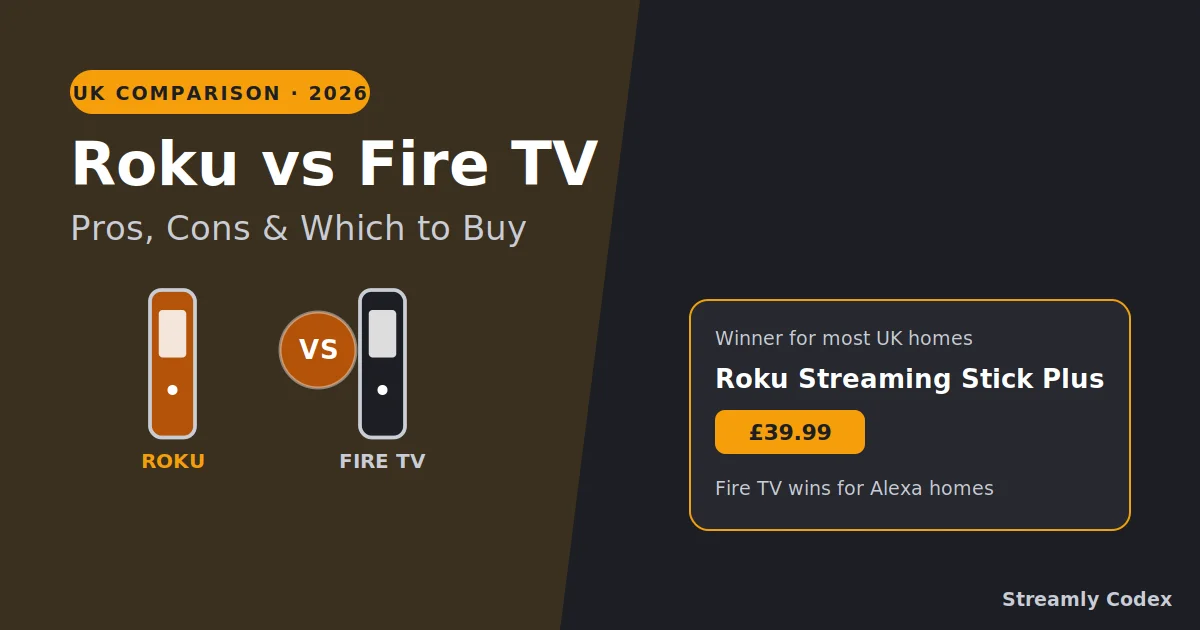
Overall winner for most UK homes: the Roku Streaming Stick Plus at £39.99. It does everything most people need, for less, with a tidier interface. Fire TV’s edge is real, but it’s specific — it’s an Alexa-home and premium-features pick.
Check the Roku Price → Check the Fire TV Price →Roku vs Fire TV: At a Glance
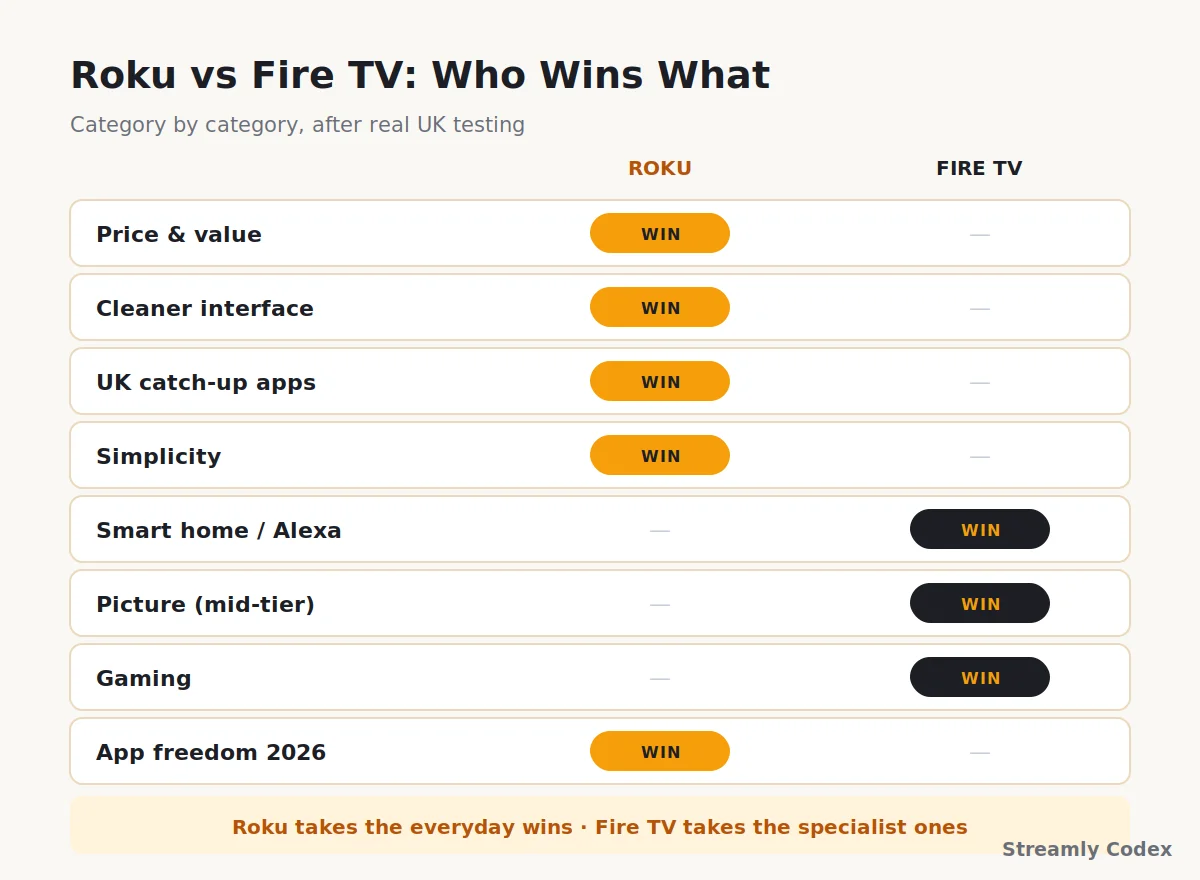
| Category | Winner | In short |
|---|---|---|
| Price & value | Roku | Streaming Stick Plus £39.99 undercuts Fire TV’s 4K sticks |
| Cleaner interface | Roku | Far fewer ads and promo rows |
| UK catch-up apps | Roku | Rock-solid iPlayer, ITVX, Channel 4 |
| Simplicity | Roku | Easiest to set up and hand to a parent |
| Smart home / Alexa | Fire TV | Built-in Alexa, Echo, Ring, routines |
| Picture (mid-tier) | Fire TV | 4K Max adds Dolby Vision + Wi-Fi 6E |
| Gaming | Fire TV | Xbox Game Pass cloud gaming built in |
| App freedom (2026) | Roku | Fire TV’s new Vega sticks limit apps — see below |
Tally it up and Roku takes the everyday categories — price, interface, apps, simplicity — while Fire TV wins the specialist ones — Alexa, premium picture, gaming. That split is the whole comparison in a nutshell, and it’s why “which is better” genuinely depends on your home.
Full Comparison: Roku vs Fire TV (2026)
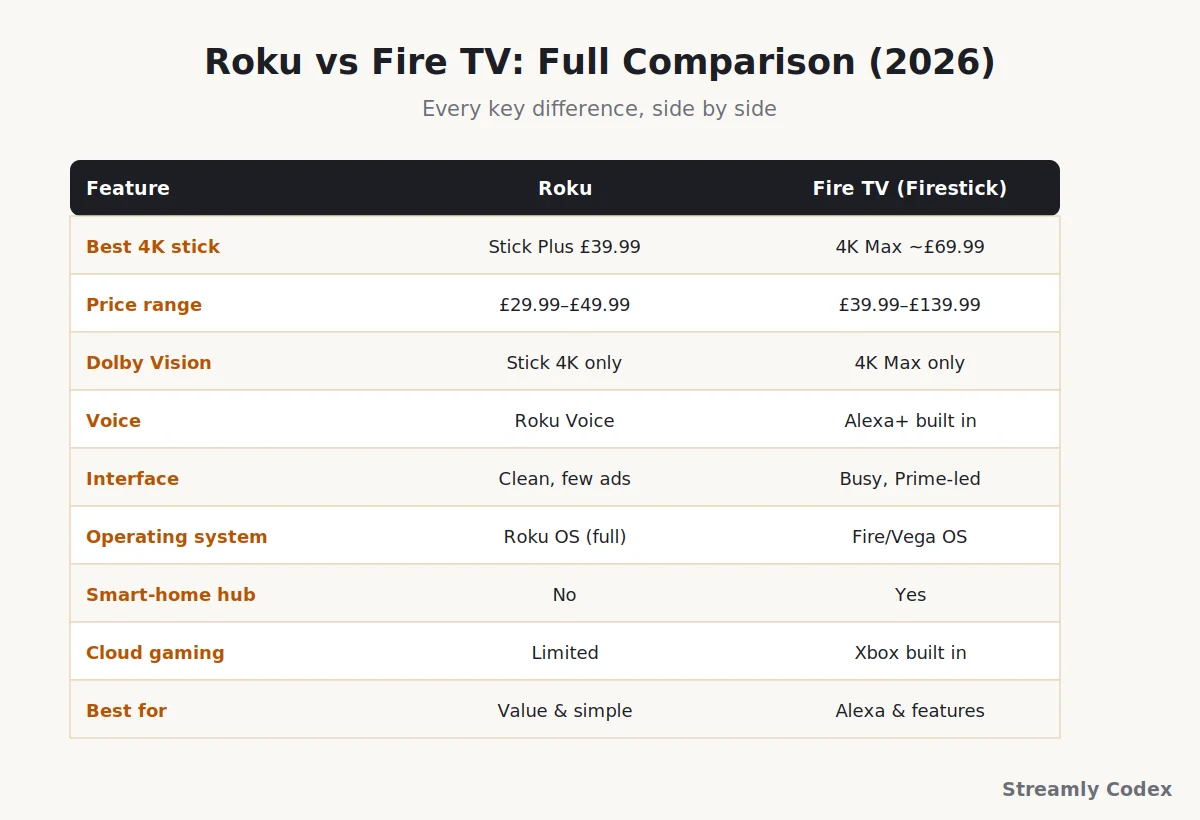
| Feature | Roku | Fire TV (Firestick) |
|---|---|---|
| Best-value 4K stick | Streaming Stick Plus — £39.99 | Fire TV Stick 4K Max — ~£69.99 |
| Price range | £29.99–£49.99 | £39.99–£139.99 |
| Dolby Vision | On Streaming Stick 4K only | On 4K Max only |
| HDR10 / HDR10+ | Yes | Yes |
| Voice assistant | Roku Voice (+ works with Alexa/Google) | Alexa built in (now Alexa+) |
| Interface | Clean, minimal ads | Busy, Prime-focused |
| Operating system | Roku OS (full app store) | Fire OS or new Vega OS (limited) |
| Smart home hub | No native hub | Yes (esp. Fire TV Cube) |
| Cloud gaming | Limited | Xbox Game Pass built in |
| Best for | Value & simplicity | Alexa homes & features |
Two rows there deserve a closer look, because they’re where the real 2026 differences hide: price (the gap is bigger than people expect) and operating system (Fire TV’s new Vega OS changes what apps you can install). Let’s take them in turn.
Price: Roku vs Fire TV in the UK
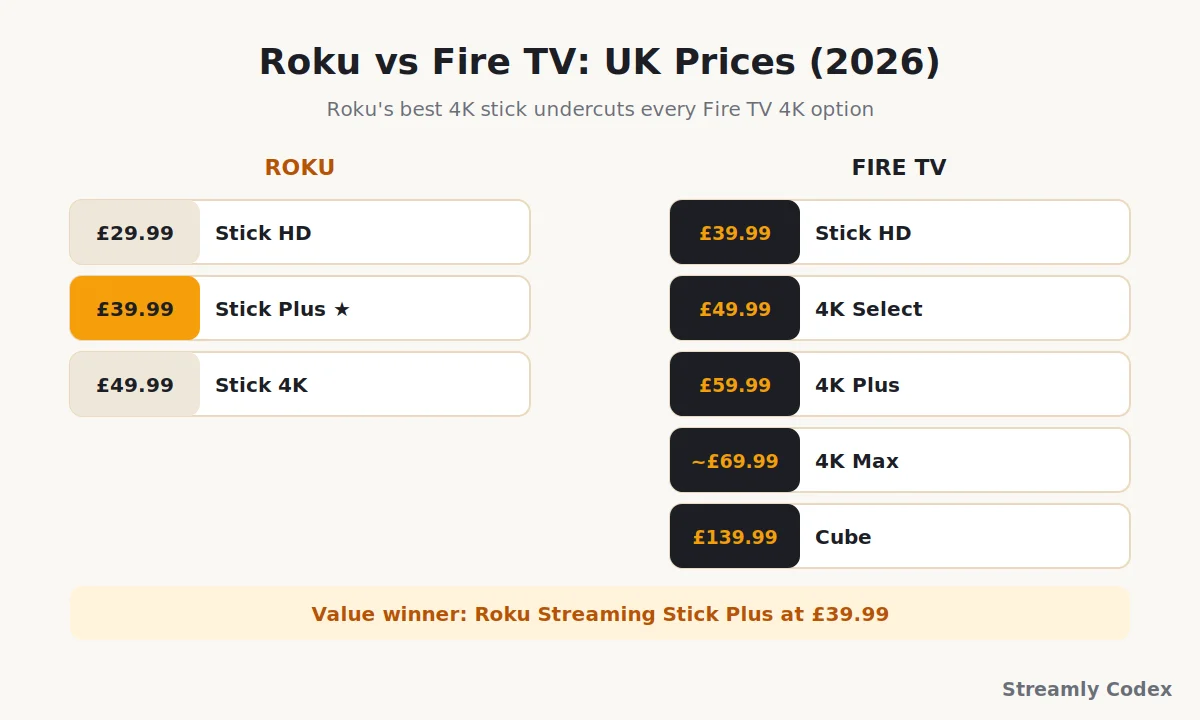
Both brands run frequent sales, so treat these as guide prices and always check the live listing — but the RRP picture in 2026 looks like this:
| Roku | Price | Fire TV | Price |
|---|---|---|---|
| Streaming Stick (HD) | £29.99 | Fire TV Stick HD | £39.99 |
| Streaming Stick Plus (4K) | £39.99 | Fire TV Stick 4K Select | £49.99 |
| Streaming Stick 4K (Dolby Vision) | £49.99 | Fire TV Stick 4K Plus | £59.99 |
| — | — | Fire TV Stick 4K Max | ~£69.99 |
| — | — | Fire TV Cube | £139.99 |
The takeaway is simple: Roku’s best 4K stick costs less than any of Fire TV’s 4K options. The Streaming Stick Plus at £39.99 gives you genuine 4K HDR10+ for less than the £49.99 Fire TV Stick 4K Select — and with a cleaner interface. Fire TV only pulls level on hardware once you reach the £69.99 4K Max, which then justifies its price with Dolby Vision and Wi-Fi 6E. For pure value, Roku wins this round comfortably.
The Big 2026 Change: Fire TV’s New Vega OS
This is the update that most “Roku vs Fire TV” articles haven’t caught up with, and it genuinely affects which you should buy. In 2026, Amazon began moving Fire TV away from its Android-based system to a brand-new operating system called Vega OS. Going forward, its newer, cheaper sticks run Vega — and that comes with real trade-offs.
Vega OS sticks (the Fire TV Stick 4K Select and the 2026 Fire TV Stick HD) support a much smaller app selection — around 900 apps — and no sideloading, so you can’t install apps from outside the official store. All the major names — Netflix, Disney+, iPlayer, ITVX, Prime — are there, but niche apps and tinkering are off the table. Only the older Android-based sticks — the Fire TV Stick 4K Plus and the premium 4K Max — keep the full app library and sideloading.
Roku doesn’t have this split. Every current Roku runs the same Roku OS with the same full app store, so you don’t have to decode which model gives you which apps. If app freedom or simplicity matters to you, this is a quiet but real point in Roku’s favour in 2026.
Roku vs Fire TV: Head to Head
Value
Roku wins. The Streaming Stick Plus is £39.99 for real 4K HDR10+, undercutting every Fire TV 4K stick. Fire TV only matches the hardware at £69.99 (the 4K Max), and even then Roku’s cheaper model covers what most people actually watch. If you’re spending your own money and want the most streaming for the least, Roku is the pick.
Picture quality
A tie that tips on budget. At the top, both are excellent — the Roku Streaming Stick 4K and the Fire TV Stick 4K Max both do Dolby Vision, HDR10+, and Dolby Atmos. The difference is where Dolby Vision sits in each range: on Roku it’s the £49.99 Stick 4K, on Fire TV it’s the £69.99 4K Max. If you have a Dolby Vision TV and want it cheapest, Roku gets you there for less. For the best all-round picture-and-speed package, the 4K Max with Wi-Fi 6E edges ahead.
Interface and ads
Roku wins, clearly. Its home screen is a simple grid of your apps with minimal fuss. Fire TV’s interface has grown busier every year — full of Prime Video promotions, sponsored rows, and recommendations that push Amazon’s own content. Some people don’t mind it; plenty find it tiring. If a calm, ad-light screen matters, Roku is the more relaxing place to live.
Apps (UK)
Roku edges it, and Vega OS widens the gap. Both cover the essentials — iPlayer, ITVX, Channel 4, My5, Now, Netflix, Prime, Disney+. But every Roku runs the same full app store, while Fire TV’s new Vega sticks limit you to around 900 apps with no sideloading. For most people the big apps are all present on both; for anyone who wants niche apps or flexibility, Roku is safer.
Smart home and Alexa
Fire TV wins, decisively, if you own Alexa kit. It has Alexa built in (now the smarter Alexa+), so you can control Echo speakers, Ring cameras, and smart-home routines straight from the TV and remote. Roku works with Alexa and Google Assistant as external helpers, but it isn’t a smart-home hub itself. In an Alexa house, Fire TV is the natural fit — this is its single strongest card.
Gaming
Fire TV wins. The Fire TV Stick 4K Max supports Xbox Game Pass cloud gaming, so you can stream console games with a compatible controller — no console needed. Roku’s gaming is limited to casual apps. If playing games on the streaming stick appeals, Fire TV is the only one of the two that does it properly.
Voice remote
A tie. Both include a voice remote with power and volume buttons for your TV. Fire TV’s Alexa is more capable for smart-home commands; Roku Voice is perfectly good for finding shows. Neither will disappoint.
Roku vs Fire TV: Pros and Cons
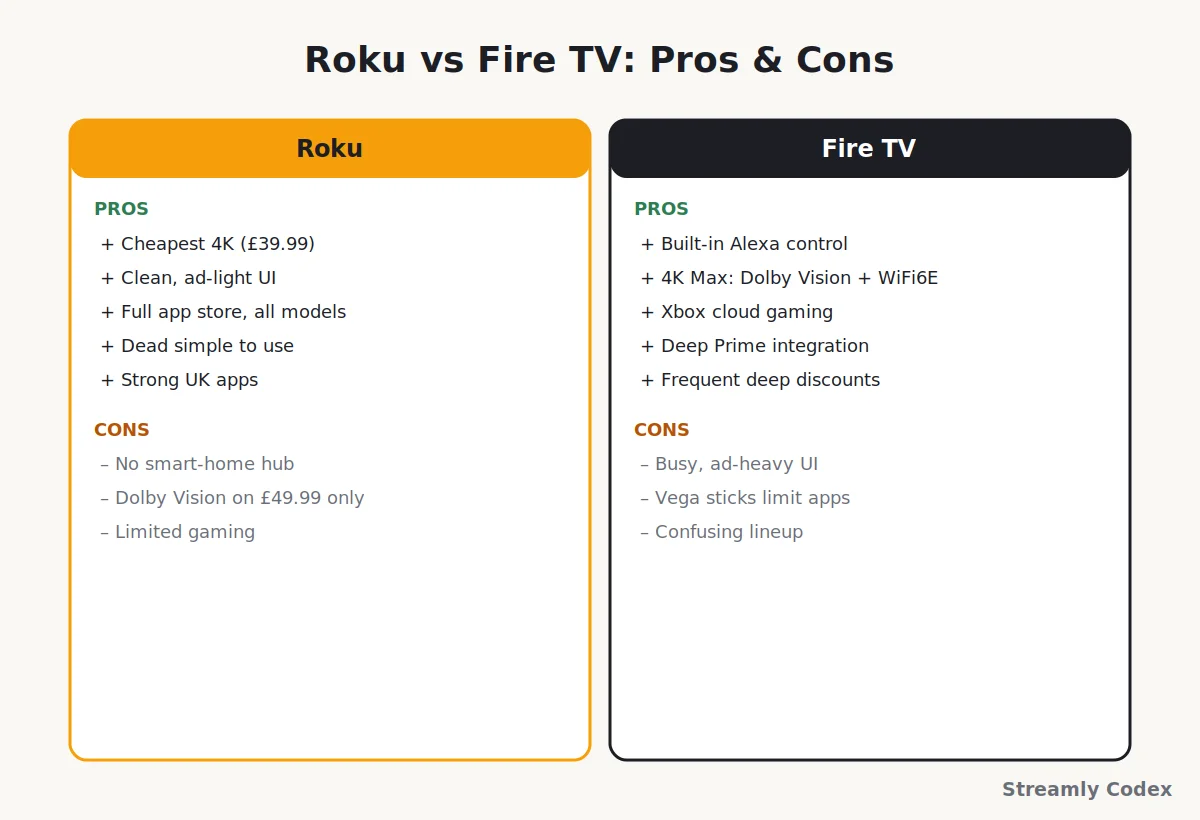
Roku
✔ Pros
- Cheapest genuine 4K (Stick Plus £39.99)
- Clean, ad-light interface
- Same full app store on every model
- Dead simple to set up and use
- Strong UK catch-up apps
- Neutral — doesn’t push one service
✘ Cons
- No native smart-home hub
- Dolby Vision only on the £49.99 model
- Limited gaming
- Hardware is functional, not flashy
Fire TV (Firestick)
✔ Pros
- Built-in Alexa and smart-home control
- 4K Max: Dolby Vision + Wi-Fi 6E
- Xbox cloud gaming built in
- Deep Prime Video integration
- Frequent, deep discounts
✘ Cons
- Busy, ad-heavy interface
- New Vega sticks limit apps + no sideloading
- Confusing model lineup
- Best stick costs more than Roku’s
Which Is Better for the UK?
For UK buyers specifically, Roku has a slight home advantage. Its interface stays clean, its UK catch-up apps (iPlayer, ITVX, Channel 4, My5) are reliable, and the £39.99 Streaming Stick Plus is the best-value 4K streamer on British shelves. It’s the one I recommend to most people who just want to watch telly without thinking about it.
Fire TV makes more sense for UK homes that have bought into Amazon — Prime Video subscribers, Echo speaker owners, Ring doorbell users. In that setup the Alexa integration is genuinely useful, and the 4K Max is a lovely bit of kit. Both work perfectly across the UK and Europe; the deciding factor is your ecosystem, not your postcode.
Which Should You Buy?
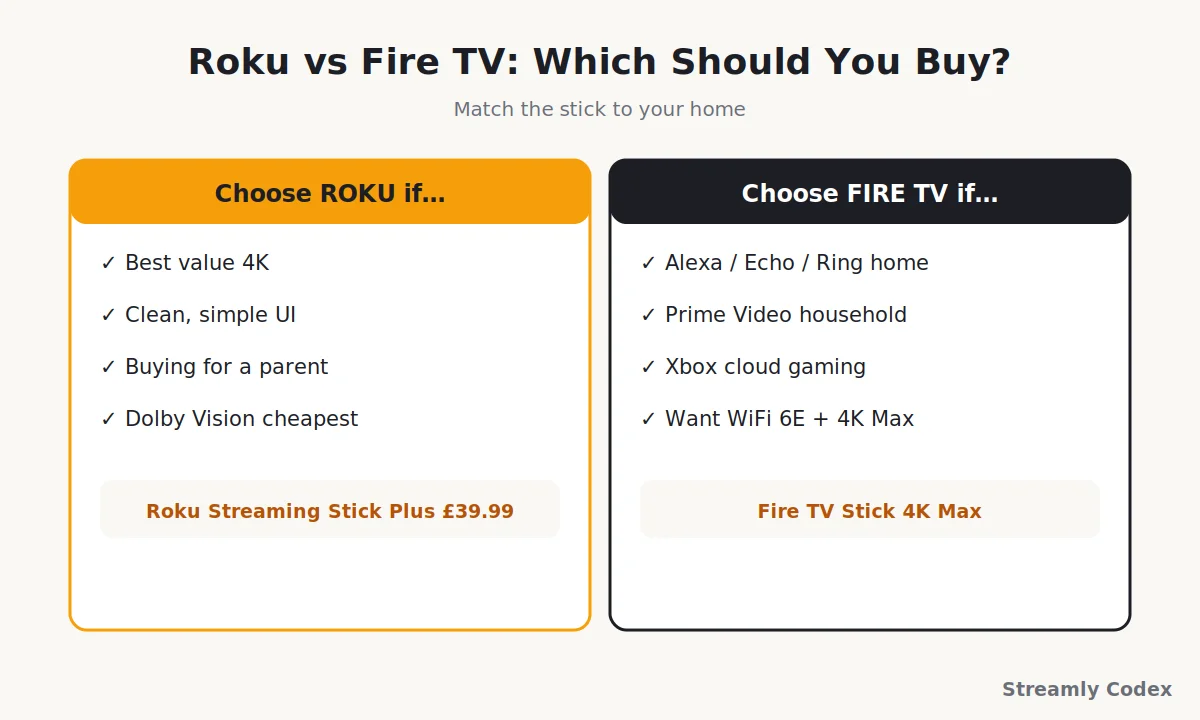
| Your situation | Buy this |
|---|---|
| Just want the best value 4K | Roku Streaming Stick Plus (£39.99) |
| Want a clean, simple interface | Roku |
| Home runs on Alexa / Echo / Ring | Fire TV Stick 4K Max |
| Want Dolby Vision cheapest | Roku Streaming Stick 4K (£49.99) |
| Prime Video household | Fire TV |
| Want Xbox cloud gaming on TV | Fire TV Stick 4K Max |
| Buying for a parent / non-techy | Roku |
See how each brand’s full range stacks up in our best Roku devices guide and Fire TV Stick 4K Max review. For the whole market, see our best streaming device UK guide.
How I Tested
This comparison comes from 06 months with both brands, not spec sheets:
- Roku and Fire TV sticks on the same TCL and Samsung TV with connected Roku and Fire TV devices, swapped daily
- Same apps on both — Netflix, iPlayer, ITVX, Prime, Disney+, YouTube
- App launch speed, 4K HDR and Dolby Vision playback compared directly
- Alexa and Roku Voice tested with everyday requests and real accents
- Wi-Fi stability checked on a 40 Mbps connection with 08 devices online
Prices were checked against UK retailers on the day of publishing. Both brands discount often, so always tap through for the live price.
Roku vs Fire TV: FAQs
Which is better, Roku or Fire TV?
For most people in the UK, Roku — it’s cheaper (£39.99 for the Streaming Stick Plus), has a cleaner interface, and is simpler to use. Fire TV is better if your home runs on Alexa or you want Dolby Vision plus Wi-Fi 6E on the 4K Max.
What are the main pros and cons of Roku vs Fire TV?
Roku’s pros are price, a clean interface, and a full app store on every model; its con is no smart-home hub. Fire TV’s pros are built-in Alexa, Xbox cloud gaming, and Dolby Vision on the 4K Max; its cons are a busy, ad-heavy interface and app limits on the new Vega OS sticks.
Is Roku or Firestick cheaper?
Roku. Its best 4K stick, the Streaming Stick Plus, is £39.99 — cheaper than any of Fire TV’s 4K sticks. Fire TV sticks do drop lower than Roku during Prime Day and Black Friday sales, though.
Roku or Fire TV — which has the cleaner interface?
Roku. Its home screen is a simple grid of your apps with minimal advertising. Fire TV pushes Prime Video and sponsored content much more heavily.
Which is better for Alexa users?
Fire TV. It has Alexa built in (now Alexa+) and works directly with Echo speakers, Ring cameras, and smart-home routines. Roku works with Alexa only as an external assistant.
What is Fire TV’s Vega OS and does it matter?
Vega OS is Amazon’s new operating system replacing Android on its newer, cheaper Fire TV sticks. It supports around 900 apps and no sideloading. The big apps are all there, but if you want niche apps or flexibility, Roku’s full app store is the safer choice.
Roku or Fire TV for elderly or non-technical users?
Roku. Its simple, consistent interface and easy setup make it the friendlier choice for anyone who just wants to press a button and watch.
Do both work with UK catch-up apps?
Yes. iPlayer, ITVX, Channel 4, My5, and Now all run on both Roku and Fire TV. A TV Licence is still required for iPlayer and live TV.
Which has better picture quality?
They’re evenly matched at the top — both the Roku Streaming Stick 4K and Fire TV Stick 4K Max do Dolby Vision and HDR10+. Roku offers Dolby Vision more cheaply (£49.99); the 4K Max adds Wi-Fi 6E for the best all-round performance.
Can you play games on Roku or Fire TV?
Fire TV is far better for gaming — the 4K Max supports Xbox Game Pass cloud gaming with a compatible controller. Roku only offers casual games.
Related Guides
- 👉 Best Streaming Device UK (2026)
- 👉 Best Roku Streaming Devices
- 👉 Fire TV Stick 4K Max Review
- 👉 All streaming device comparisons
Final Verdict: Roku vs Fire TV
After 06 months with both, my answer is straightforward. For the majority of UK homes, Roku is the better buy — the £39.99 Streaming Stick Plus is cheaper than any Fire TV 4K stick, the interface is cleaner, it’s simpler to use, and every model gives you the full app store without the Vega OS limits. It’s the one I’d hand almost anyone.
Buy Fire TV instead if your home runs on Alexa, you’re deep in Prime Video, or you want the specific strengths of the 4K Max — Dolby Vision, Wi-Fi 6E, and Xbox cloud gaming. In those homes its extra features genuinely earn their place.
My final word: match the stick to your home. Most people should save their money and buy the Roku. Alexa households and feature-chasers will be happier with a Fire TV.
Check the Latest Roku Price → Check the Latest Fire TV Price →